ב"ה

The founder of Chabad Chasidism, Rabbi Schneur Zalman of Liadi, known as the Alter Rebbe, was arrested by the Czarist authorities in Russia. He was accused of treason, aiding the Czars enemies in the Ottoman Empire. In reality, he was simply urging his followers to send charity to the poor Jews of Israel. Spiritually speaking, there was another reason that heaven orchestrated the arrest: the Alter Rebbe was spreading the secrets of Chasidism too widely.


From Likutei Sichos - Vayishlach
Jacob hid his daughter from the wicked Esau. But did Dinah actually have the power to make Esau repent? Based on the commentary of Rashi on the verse (Genesis 32:23) "And [Jacob] arose during that night, and he took his two wives and his two maidservants and his eleven children, and he crossed the ford of [the River] Jabbok." From Likutei Sichos, vol. 35, pp.150-155.


The founder of Chabad Chasidism, Rabbi Schneur Zalman of Liadi, known as the Alter Rebbe, was arrested by the Czarist authorities in Russia. He was accused of treason, aiding the Czars enemies in the Ottoman Empire. In reality, he was simply urging his followers to send charity to the poor Jews of Israel. Spiritually speaking, there was another reason that heaven orchestrated the arrest: the Alter Rebbe was spreading the secrets of Chasidism too widely.


Inside the story of Tevet 5: the victory of the sacred books
Jewish Educational Media pulls back the curtain on the fascinating saga of the violation of Lubavitch’s sacred manuscripts and books—and their ultimate triumph. From the Rebbe’s earliest public references to the theft of Chabad’s treasured library, it was clear that this was a spiritual struggle over the movement’s very soul—as embodied in its holy writings—and even over the very definition of a rebbe. (Excerpt from the complete film)




The Biblical story of Joseph’s descent into Egypt and subsequent incarceration is often read in the same week in which we celebrate the liberation from Czarist imprisonment of the Alter Rebbe, Rabbi Schneur Zalman, founder of Chabad. This class will explore the link between these events and offers insight into the nature of redemption. (Likutei Sichos volume 25, Parshas Vayeishev)


In his commentary on Genesis 37:2, Rashi says that "Jacob dwelt" can also mean that "Jacob sought to dwell in tranquility." Is seeking tranquility and happiness an inherently valuable pursuit? Is it okay to ask G-d to help us accomplish our mission free from distractions? From Likutei Sichos, vol. 30, pp.176-183.


Parsha Curiosities: Vayeishev
A fascinating peek behind the curtain on the biblical narrative of the outrageously salacious advances made by Potiphar’s wife as she lustfully attempted to seduce the strikingly handsome Joseph. Amazingly shedding lots of light on the true story of how he overcame this terrible temptation so propitiously.

Exploring Rashi’s commentary on where Jacob sends Joseph
When Jacob sends Joseph to find his brothers, he unwittingly sends him into a trap that would see Joseph sold into slavery. The Torah mentions that the place where this all happened was in Shechem, implying Shechem is a place infamous for tragedy. Or, is it?


The nineteenth of Kislev marks the release of Rabbi Shneur Zalman of Liadi from imprisonment in Czarist Russia. He was imprisoned as a result of his efforts in spreading chasidic teachings, but it was only after this that he was able to continue his work without hindrance, and with greater success and intensity.

The Torah relates how our forefather Jacob behaved when he dwelled with Laban. Overcoming all the challenging circumstances he found himself in, he remained loyal and true to serving G-d despite them. While this steadfastness was a clear demonstration of where Jacob’s true allegiance lay, it still wasn’t the true fulfilment of his potential.


The Torah portion begins with Jacob’s return to his father’s home, “And Jacob dwelt in the land of his father's sojourning…These are the generations of Jacob… Following a brief overview of the different interpretations in the commentaries on this verse, we focus on Rashi’s commentary, which explains with a parable of a pearl lost in the sand. When examining nuances in the manuscript, we can attempt to better understand the precise details employed in the parable.





Children’s Rally, 25 Kislev, 5741 • December 3, 1980
The Chanukah battle and victory were immortalized by the Sages. The candles evoke the memory of the small group of Jews who fought those who had opposed the Torah.
Today, we each battle our own evil inclination as well. Our victories, as well, will be eternally remembered.
Our current mission and battle is for the coming of Moshiach, as we request three times a day during prayer. Although we only request his coming three times a day, we yearn for him “all day”!



7th Night of Chanukah, 5748 · December 21, 1987
When a Jew celebrates Chanukah, he may be confronted: “You Jews are so few compared to
the nations of the world. Yet you hold fast to your customs and commandments, ignoring what
the billions of non-Jews around you think and do… Wherein lies your strength to stand in the
face of such odds?”






Chanukah reminds every Jew that it is G-d’s eternal mandate to carry the torch of His
“Mitzvah-candle and Torah-light.” With most Mitzvos, the “candle” and “light” are not
physically visible. But with the Chanukah candles we see how fulfilling the Mitzvah creates
actual physical light that illuminates all one’s surroundings.


Two Versions of the Timeline of the Maccabee's Victory
Among the early Talmudic commentaries, there are two opinions about the chronology of events commemorated on Chanukah. One says that the war was won on the 24th of Kislev and that the first day of Chanukah, the 25th of Kislev, is the anniversary of the first day of peace. The other says that on one day, the 25th of Kislev, the Maccabees both won the war and rededicated the Temple.


Solomon’s Temple Dedication and the Blueprint of Prayer
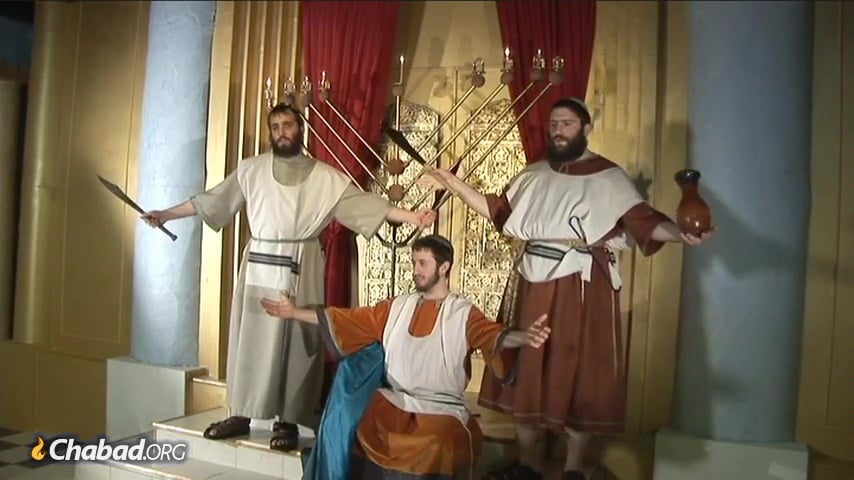
The First Temple is complete. It is the absolute zenith of Jewish history. Standing before an ecstatic nation, King Solomon delivered a prayer that answered the ultimate paradox: How do you fit an infinite G-d inside a finite building? Unpack this address
Get the Chabad.org Video app